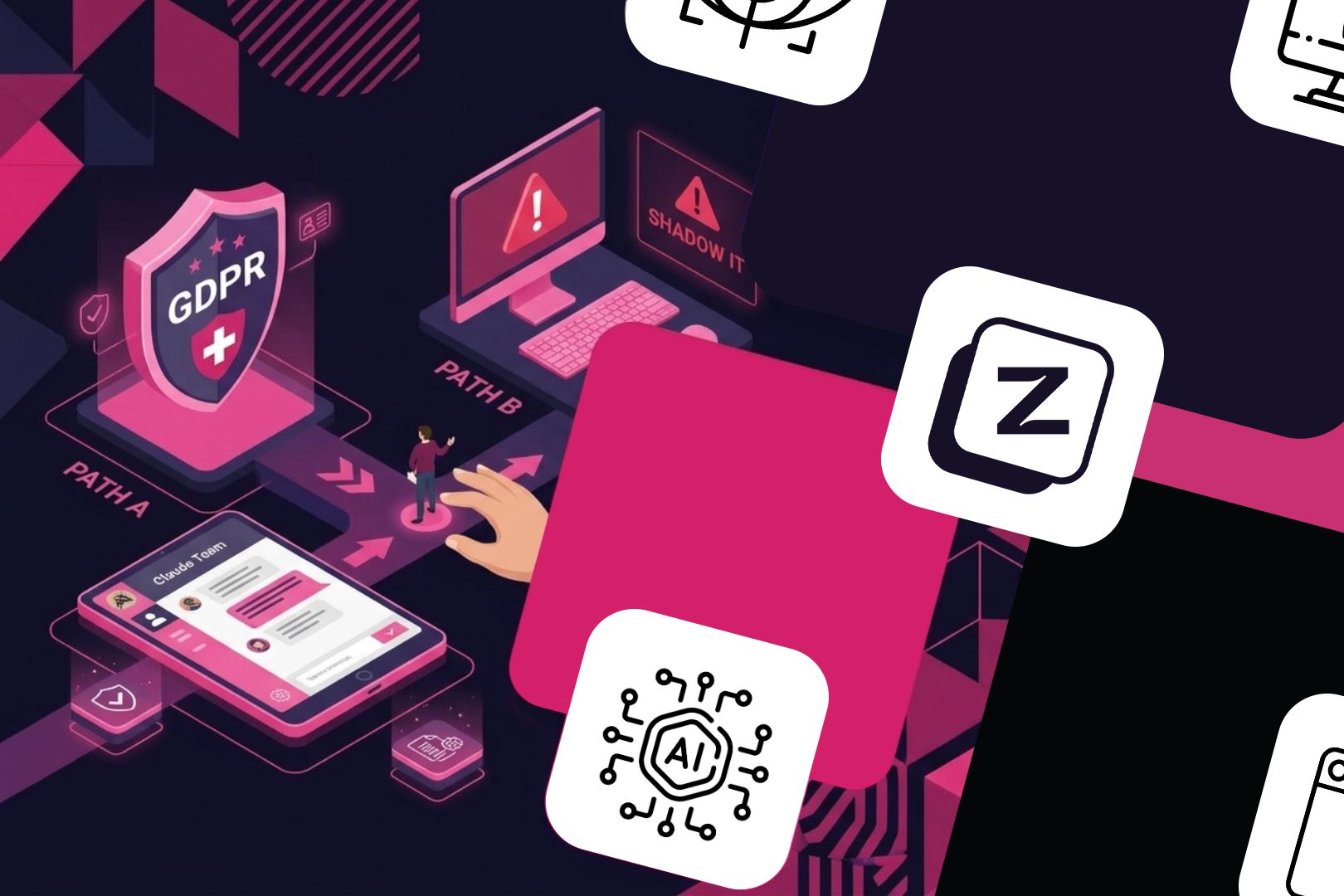
Your employees are already using AI. The question is no longer “should we do more?” It is “how do we do it right, and build something that actually works for the company?”
Your Employees Are Already Using AI, But Not the Way You Think
Let’s be direct. According to a 2024 KPMG survey, over 70% of employees in European companies already use AI tools at work, most of them without their employer’s knowledge or policy framework. Your teams are using ChatGPT, Gemini, or Claude, on their own accounts, on their own terms, pasting client emails, financial data, internal documents, and strategic notes into tools they signed up for with a personal Gmail address.
This is called Shadow IT. And it is not a future risk. It is happening right now.
The problem is not that your employees use AI. It is that they use it without governance, without shared context, and without any data protection framework. Every team member builds their own habits, their own prompts, their own workarounds. Nothing is shared. Nothing is controlled. Nothing compounds.
You do not have an AI system. You have a collection of individual experiments.
The bigger question here is not whether AI belongs in your company. It already is. The question is who is in control of how it operates.
What a Real AI System Looks Like for an SME
A proper AI system for an SME is not:
- a chatbot on your website, or a “basic RAG” that answers questions from a PDF
- a list of AI tools you see on LinkedIn by every new “AI-Expert freelancer”
A real AI system means:
- Shared context across your teams: so the AI knows your clients, your processes, your terminology
- Skills and workflows designed around how your company actually operates
- Onboarding so every team member uses it the same way, from day one
- Connections to your tools: your CRM, your email, your project management, your data sources
- Governance: clear rules on what data goes in, what stays out, and who controls what
This is what the Z Digital Agency team builds. Not a tool. A system.
Before we get there, there is one question every CEO asks, and it is the right question.
“What About Our Data?” The Honest Framework
This is where most AI conversations stall. And it is where most vendors get deliberately vague.
We will not. Here is the framework.
Two Concepts, Not One
Most people conflate two very different things:
| Data Processing | Data Residency | |
|---|---|---|
| The question | Is my data used to train the AI model? | Where is my data physically stored? |
| Why it matters | Your competitive intelligence could improve a model used by your competitors | Certain regulations require data to stay within specific geographic boundaries |
| The honest answer | Solved. Contractually guaranteed with enterprise AI plans. | Depends on your legal obligations and your risk tolerance. |
Understanding this distinction is the first step to making a clear, well-documented decision instead of an anxious one. Most Swiss SMEs are stuck not because of a real legal blocker, but because no one has taken the time to separate these two questions.
This is exactly what a rigorous GDPR and FADP compliance posture requires: not fear, but a documented decision made with full information.
Data Processing: A Solved Problem
With Claude Team (the enterprise plan from Anthropic, the company behind Claude):
- Your data is NOT used for model training: this is a contractual guarantee, not a marketing claim
- A Data Processing Agreement (DPA) with Standard Contractual Clauses is automatically included, compliant with both GDPR and Swiss FADP
- Anthropic acts as data processor; your company remains the data controller
- Infrastructure is SOC 2 Type II and ISO 27001 certified
This is enterprise-grade data protection. Not a checkbox on a settings page.
Data Residency: The Honest Answer
Here is where the Z Digital Agency team will not sugarcoat it: Claude’s data, like all other major AI providers, is processed in the United States. There is no EU or Swiss instance of claude.ai, not on Team, not on Enterprise. This is a fact, not a configuration option.
So what does that mean for your company?
Two Paths, One Framework for Swiss and European SMEs
Path A: For Most Swiss and European SMEs
When data residency is a preference, not a legal blocker.
This applies to the vast majority of Swiss SMEs. If you are not in a heavily regulated sector (banking, health, certain public sector roles), here is the legal reality:
- Claude Team + Standard Contractual Clauses is legally defensible under the Swiss Federal Act on Data Protection (FADP) for US data transfers
- The EU-US Data Privacy Framework provides additional legal basis
- Combined with disabling feedback sharing and training your team on what not to input, this constitutes a reasonable and documented compliance posture
What the Z Digital Agency team delivers on Path A:
A complete, ready-to-use AI system for your company, built on Claude Team, using our proven framework of shared context, custom skills, team onboarding, and tool integrations.
- Deployed within one week
- Full team onboarding within one month
- Immediately more secure than employees sending files and emails into personal ChatGPT accounts
This is our recommended starting point. Here is why.
AI is evolving fast. New capabilities ship every month: better reasoning, new integrations, multimodal features, agent workflows. A system built on a leading AI platform gives you access to these improvements as they arrive. You stay current without rebuilding.
More importantly, a real AI system needs to connect to external tools to actually perform actions: your CRM, your calendar, your analytics, your communication tools. These integrations are built into the platform ecosystem. You do not just chat with AI. You work with it.
Starting with Path A means you are operational in weeks, not months. You learn what works for your teams, you refine your workflows, and you build institutional AI knowledge, all while being legally covered.

Path B: When Data Residency Is a Hard Legal Requirement
For finance, healthcare, and regulated industries.
If your legal counsel or your regulator says data must stay in Europe, there are two options:
Option 1: Local Models
Running open-source models (like Llama or Mistral) on your own infrastructure or a Swiss cloud provider.
The upside: Full control. Data never leaves your perimeter.
The reality: These models are capable for conversations, but they are slower, less flexible, and miss the constant stream of new features that frontier models receive. Building an entire AI system on local models means you are maintaining infrastructure, managing updates yourself, and you cannot easily connect to the broader ecosystem of AI-powered tools and integrations.
The Z Digital Agency team has seen this pattern before in Switzerland. Think about the ERPs that were built locally 15 years ago: no API, sometimes still accessed via Citrix, impossible to change or integrate with modern tools. Local is not always better. It needs to be favored when it genuinely makes sense, for specific, contained use cases where data sensitivity is absolute. Not as a default out of fear.
Option 2: Frontier Models via EU-Hosted Infrastructure
Using Claude or other frontier models through AWS Bedrock (Frankfurt region) or Google Vertex AI (EU regions). Bedrock allows organizations to select specific, geographically constrained AWS regions to host their data and models, ensuring compliance with strict data protection regulations including GDPR.
The upside: You get frontier AI capabilities with actual EU data residency. The models evolve. The integrations work. You are not locked into yesterday’s technology.
The reality: This means API access, not a ready-made web interface like claude.ai. It requires building a custom UI/UX layer for your teams. This is real web development and AI infrastructure work, roughly five times the investment of a Path A deployment, before you even start customizing the system to your company.
The Z Digital Agency team has done it. Our project Sommelier.bot is built exactly this way: a customer-facing multi-client AI application with full control over data flows, hosted on compliant AWS infrastructure.
For larger projects, or when you need customer-facing AI applications, this is our recommendation. But it is a bigger investment, a longer timeline, and requires a clear product vision before you start.
Why Path A Is the Right First Move for 90% of SMEs
For most Swiss and European SMEs, Path A is the right foundation:
- It is legally sound: SCCs + DPA + documented data handling policies = defensible compliance
- It is fast: operational in a week, team onboarded in a month
- It is a system, not a toy: shared context, skills, workflows, integrations
- It replaces Shadow IT: which is your actual biggest data risk right now
- It lets you learn: you discover what AI actually does for your business before committing to heavy infrastructure
- It learns from you: at ZDA we build a flywheel for our clients, meaning a system that compounds with your usage, updating context, skills, and tools in the background
Path B is there when you need it. And because the Z Digital Agency team has built both, we can help you transition when the time comes.
The Z Digital Agency team has written more about this in the context of real AI for SMEs beyond the hype and at what point technology stops serving the business.
From Decision to Pilot: How ZDA Sets Up Your AI System
You do not need to transform your entire company overnight. You need to start with the right foundation.
Here is what a pilot with Z Digital Agency looks like:
- Assessment: we audit your current AI usage, your data sensitivity profile, and your legal obligations
- Decision framework: together, we document your Path A or Path B decision with clear rationale
- System setup: we deploy your AI system with shared context, custom skills, and tool integrations
- Team onboarding: we train your teams to use the system effectively and safely
- Iteration: we refine based on real usage, real feedback, real results
No vague promises. No “AI strategy decks” that sit in a drawer. A working system, in your team’s hands, within weeks.
Understanding these principles is the first step. Deploying them consistently, connecting every workflow, ensuring every team member uses the system rather than going back to their personal ChatGPT account: that is where most companies hit a wall. The Z Digital Agency team has done this setup for SMEs across Switzerland and Europe, and the pattern is always the same. The companies that move fastest are not the ones who spent the longest planning. They are the ones who made a clear decision, documented it, and started.
Does AI make company leadership easier, or does it expose the leaders who were never really building institutional knowledge in the first place? That question is worth sitting with. Because a real AI system does not just help you do things faster. It forces you to clarify what your company actually knows, how it operates, and what it stands for. That is uncomfortable. It is also valuable.
Try our senior expertise for FREE
Share your current challenge and get a clear solution in 30 minutes with one of our senior experts. Precise, actionable, and with no obligation.