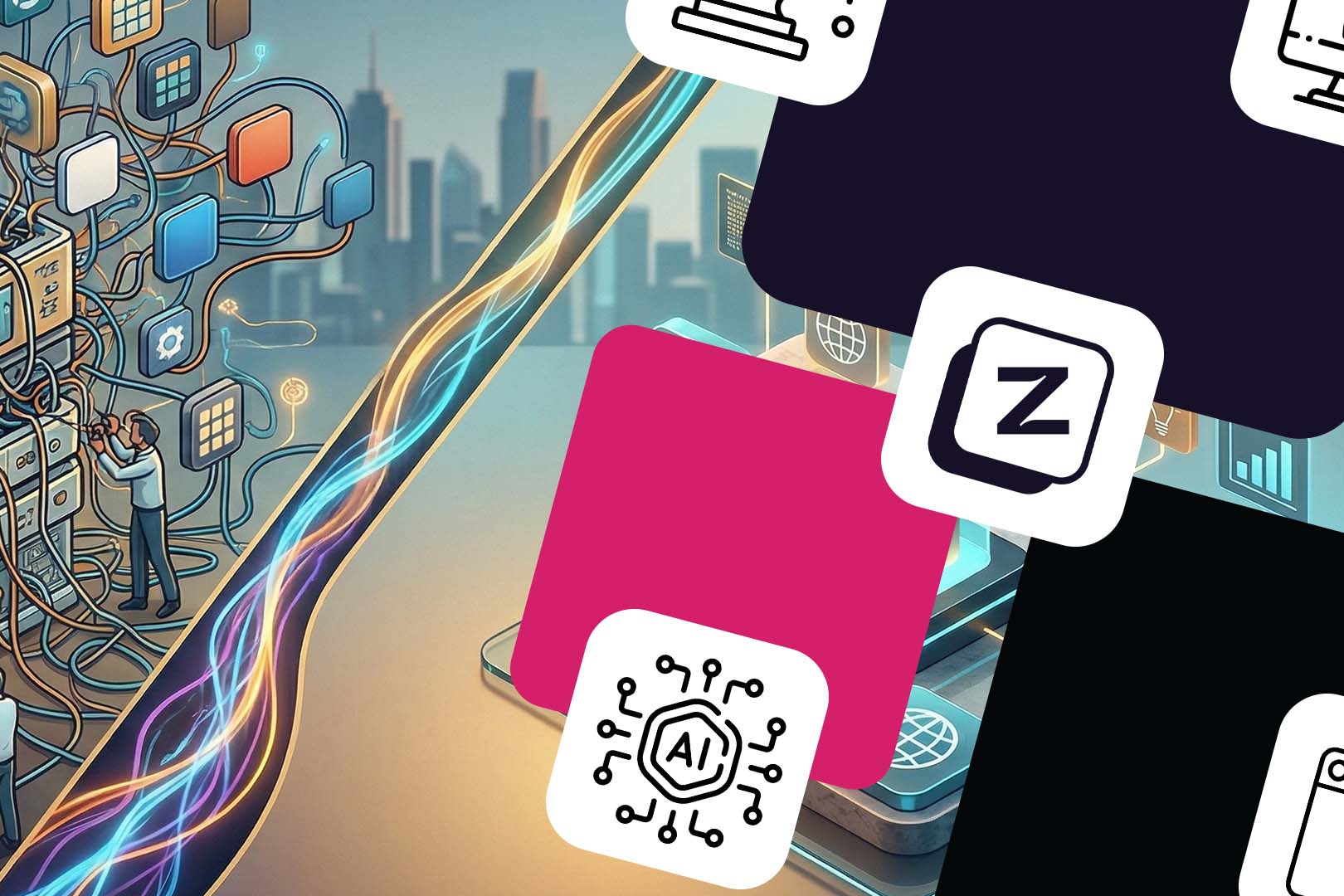
The most dangerous assumption companies hold in 2026 is that competitive advantage comes from adding. A bigger stack. More integrations. Another AI agent. Another platform. But the companies pulling away from the pack aren’t the ones with the longest feature lists or the deepest vendor relationships. They’re the ones ruthlessly subtracting.
Most SMEs now operate 15 to 30 tools simultaneously, and most employees can’t explain how half of them connect. The Z Digital Agency team sees this pattern repeatedly in its content creation and development work: teams spend more time maintaining their infrastructure than delivering value to clients. They’ve become operators of complexity rather than drivers of strategy. And while they’re managing connections between platforms, competitors with half as many tools are building actual business momentum.
By the end of this piece, you’ll understand why the next competitive advantage isn’t a new platform but the courage to delete five. And you’ll have a framework for identifying which ones.
The stack that became the strategy
In 2026, the average company deploys 93 SaaS applications, with marketing departments alone managing 65 to 75 MarTech tools. The irony is sharp: organizations now have *more* tools than ever, yet only 49% of their MarTech stack actually gets utilized. The rest exists as zombie infrastructure, consuming budget and attention.
This didn’t happen by accident. It happened because every tool came with a reasonable story. A CRM for sales. A marketing automation platform for campaigns. An analytics tool for insights. An AI agent to accelerate copy. A scheduling tool for social. A form builder for conversions. A CDP for data. Individually, each decision made sense. Collectively, they created a system that works against itself.
The cost nobody measures
The licensing fees are only half the story. BetterCloud research shows that CMOs underestimate their true MarTech costs by 40% to 60%, because the real cost lives in hours, not dollars. A marketing team that spends 60% of their week syncing data between tools, troubleshooting integrations, and managing automations isn’t doing marketing. It’s an IT department that happens to send emails.
Organizations that have executed serious consolidation report 20 to 30% total cost reduction. But the efficiency gain isn’t what moves the needle. The thing that moves the needle is time. Time to think. Time to execute. Time to measure what actually matters. Those are the things that defeat competitors.
The uncomfortable question about AI
Here’s what you’re not hearing in vendor pitches: AI hasn’t reduced tool sprawl. It has accelerated it. Every employee now has access to a generative AI tool, an AI writing assistant, an AI analytics platform, an AI scheduling tool. The democratization of AI has become the democratization of chaos.
In 2026, companies report what researchers are calling “AI brain fry.” Workers using three or fewer AI tools report increased productivity. Workers using four or more report the opposite. The mental load of evaluating outputs from multiple AI systems, reading and interpreting generated content, fact-checking suggestions, and deciding whether to act on recommendations consumes more cognitive energy than the tools save. And 34% of workers experiencing this level of AI overload report active intention to leave the company.
Think about what that means. You’ve bought tools to make people more productive. Instead, you’ve created conditions where your best people are quietly updating their LinkedIn profiles.
The tool that shouldn’t exist
The Z Digital Agency team recently worked with a Swiss logistics company that had deployed four different AI-powered writing tools, a marketing automation platform with built-in AI, an AI chatbot for customer service, and an AI analytics system, all running simultaneously. Nobody had decided this was the strategy. It had simply happened one tool at a time, each decision made in isolation, each one reasonable on its own. The company spent more time managing AI outputs than making business decisions.
The solution wasn’t a better AI tool. It was deletion.
They consolidated to one AI foundation, gave teams clear guidelines on when to use it, and freed up 8 to 10 hours per week per person. Revenue didn’t increase immediately. But decision speed did. Execution precision did. And that’s where competitive advantage actually lives.
What consolidation actually means
Consolidation is not about choosing the “best” tool. It’s about choosing the tool that forces the least friction between your team and the work that matters. Sometimes that’s the platform with the most features. Often, it’s the one with the clearest workflow and the strongest integration ecosystem. Almost never is it the tool you currently love.
The market is already moving this direction. Platforms like HubSpot, Salesforce, and Adobe are expanding their suites by absorbing adjacent categories. CRM platforms now offer marketing automation, sales engagement, and enablement bundled together. Marketing automation platforms are expanding into CDP territory. The vendors understand what’s happening: specialty tools are expensive to maintain, integrate poorly, and create cognitive overload. Suites are winning because they reduce the number of decisions a team has to make.
This doesn’t mean all specialty tools are going away. It means that specialty tools now have to solve a *very specific problem* so well that the cost of integrating them is worth the benefit they deliver. A tool that does one thing 20% better than the platform you already own probably isn’t worth the integration burden. A tool that does one thing 5x better probably is.
The quarterly tool audit framework
The Z Digital Agency team uses a simple framework for clients who want to consolidate without losing functionality.
Step 1: Map every tool and its true cost. Not just the subscription price. Map the hours your team spends learning the tool, configuring it, managing integrations, monitoring outputs, and troubleshooting problems. Add the salary cost of that time. Multiply by 12. Now you know the real cost. This is where clarity about actual costs drives better decision-making and separates good investments from bad ones.
Step 2: Ask the uncomfortable question: What would happen if we deleted this? Not “could we live without it?” but “would the business actually break if it was gone tomorrow?” If the honest answer is “no,” it’s a candidate for elimination. If the answer is “we’d have to rework three other systems,” the integration cost is part of the real cost calculation from Step 1.
Step 3: Identify redundancy. If two tools solve the same problem, one of them is overhead. This is harder than it sounds because solutions rarely do the same thing in the same way. But if both tools sit between your team and the same outcome, choose one and move on. The mental energy cost of choosing between two similar tools every time you need that capability is a real operational expense.
Step 4: Test consolidation on a small workflow first. Don’t try to migrate your entire martech operation to a new platform in one quarter. Pick one workflow, one department, one process that currently uses multiple tools. Run it through your consolidation choice for 8 weeks. Measure everything: time spent, outputs generated, decisions made. If it works, expand. If it doesn’t, you learned something with low risk.
Step 5: Set a deletion threshold. Decide in advance: any tool that costs more than [X] and delivers less than [Y] quarterly value gets cut. Then actually cut it. Most companies skip this step because deletion feels risky. It is. And that risk is exactly why it separates you from competitors who are still managing stack complexity instead of delivering strategy.

Why most consolidation efforts fail

Companies approach tool consolidation like a technology project. They write requirements. They evaluate alternatives. They negotiate contracts. They plan implementation. Then they launch, encounter resistance from teams comfortable with the old tools, and quietly let both systems run for “a transition period” that somehow becomes permanent.
The consolidation fails not because the new tool is worse, but because nobody changed the thinking behind it. The team used the old tool to execute activities that didn’t need to be executed. They’ll use the new tool the exact same way. Moving a bad process into a new platform doesn’t make it a good process. It just makes it a bad process with a higher license fee.
This is where the Z Digital Agency team’s experience becomes relevant. A comprehensive digital strategy evaluation is where most technology initiatives gain clarity. The tool consolidation that works starts with the question “What are we actually trying to achieve?” before “Which platform should we buy?”
The invisible layer most teams miss
Before you consolidate platforms, consolidate thinking. Have every team leader answer three questions about each tool they’re responsible for: What outcome does this deliver? How are we measuring success? What would we do with the time this tool frees up? If those answers are vague, no platform swap will fix it. If they’re clear, almost any consolidation will work.
This is the invisible work. It doesn’t show up in implementation timelines. It doesn’t justify the cost of consulting hours. But it’s the difference between consolidation that reduces complexity and consolidation that just swaps one mess for another.
The human element that actually drives consolidation
Here’s what the Z Digital Agency team has learned: the companies that successfully consolidate their stacks share one trait above all others. They start with clarity about who they’re trying to serve and what problems they’re trying to solve, then work backward to the minimum set of tools required. They don’t start with the tool. They start with the outcome.
Here were top AI real use cases that ZDA AI Agency team released a few months ago.
A Swiss manufacturing company the team worked with was running nine different tools to manage customer communication. They had an email platform, a ticketing system, a live chat tool, a chatbot, an AI email writer, a scheduling tool, a CRM, a feedback system, and a social listening platform. Each one generated insights. Each one tracked a slightly different metric. Nobody could answer “how is our customer satisfaction actually trending?” because every system defined satisfaction differently.
The consolidation started not with choosing a new platform but with a single conversation: what does customer success actually mean to us? Once they answered that question, the tool selection became obvious. They needed a system that unified all customer interaction in one place and measured success against a single definition. They found that system already existed in their CRM. Four of the nine tools were simply redundant. The rest were moved to secondary status, used only when their specialty added value. Annual cost went from CHF 45,000 to CHF 18,000. Productive hours went up by 12 per week per person. Customer resolution time fell by 30%.
The tool change mattered. But the change in thinking mattered infinitely more.
When consolidation becomes a competitive weapon
The Z Digital Agency team works with digital strategy and AI implementation for SMEs across Switzerland, France, and Germany. The companies that are pulling ahead in 2026 aren’t the ones with access to more advanced tools. They’re the ones with fewer tools, clearer outcomes, and more human time to allocate to strategic thinking.
This is the uncomfortable truth: your competitors aren’t beating you with better tools. They’re beating you because they’ve decided what actually matters and have the discipline to delete everything else. That courage is rare. And while it’s rare, it’s a competitive advantage.
The next time someone pitches you on a new MarTech platform, a new AI agent, a new integration point, ask them this question:
“Will this solve a problem we’ve clearly defined, or will it create new problems that we’ll need new tools to solve?”
If they can’t answer with clarity, delete it.
The time you save isn’t a side benefit. It’s the whole point.
If you’re sitting with a stack that’s become too complex to manage and you want to talk through what a consolidation strategy actually looks like for your operation, book a free 15-minute consultation with the Z Digital Agency team. The most productive hour of your quarter might be the one where you decide what to stop doing instead of what to start.
Try our senior expertise for FREE
Share your current challenge and get a clear solution in 30 minutes with one of our senior experts. Precise, actionable, and with no obligation.